Specifications
Chemistry, physical properties, prep standards, and the DFT targets that go on a drawing.
Request Full Data SheetsHow Plural-Component Polyurea Behaves on Deck
Both components are heated to roughly 160°F and delivered to the gun at about 2,000 PSI, where they mix by impingement. Reaction begins immediately — gel in three to six seconds, tack-free in ten to thirty.
On metal decking that speed produces three effects that matter. It does not run off a slope or sag on a flute wall, so vertical and inclined deck surfaces build to the same thickness as the flat pan. It does not wick into a side lap and thin out — it bridges the lap as a film. And ambient humidity has almost no window to affect it, which is why deck work can proceed in conditions that would rule out a conventional coating.
Because the material is 100% solids, nothing evaporates. The wet mil thickness is the dry film thickness, and one gallon yields 1,604 mil-sq-ft. At a typical 60-mil deck spec that is about 27 square feet per gallon before allowing for overspray and profile.
The mechanical properties are what let it live on a structural deck. Tensile of 2,500–3,000 PSI with 300–400% elongation and 400–500 pli tear strength means the membrane accommodates live-load deflection, thermal movement, and differential movement at a lap without cracking. A rigid, high-hardness coating on a deck that flexes is a coating with a crack in its future.
Typical Physical Properties — Polyurea Deck Membrane
| Property | Value |
|---|---|
| Solids by volume | 100% |
| Tensile strength | 2,500 – 3,000 PSI |
| Elongation | 300 – 400% |
| Tear strength | 400 – 500 pli |
| Shore D hardness | 45 – 50 |
| Gel time | 3 – 6 seconds |
| Tack-free time | 10 – 30 seconds |
| Adhesion to blasted steel | > 500 PSI pull-off |
| Service temperature | −40°F to 250°F |
| Coverage | 1,604 mil-sq-ft per gallon |
| Single-pass build range | 20 – 120 mil |
| Interior deck / mezzanine DFT | 40 – 60 mil (OR7K) |
| Exposed roof deck DFT | 60 – 80 mil (OR-80SLM) |
| Traffic & impact deck DFT | 80 – 120 mil (FJ1) |
| Recoat window | Up to 6 hours with no re-prep |
| Return to service | Same day, typically within the hour |
| Equipment | Plural-component proportioner + heated hose |
Surface Preparation by Deck Condition
Bare or heavily corroded deck. SSPC-SP6 commercial blast to a 2–4 mil angular profile. This is what produces the 500+ PSI adhesion figures and what a full warranty is written against.
Maintenance overcoat of sound, tight rust. SSPC-SP3 power-tool cleaning is acceptable with a reduced-warranty note. The membrane isolates tightly-adhered oxide from moisture and oxygen and arrests the reaction. Anything a scraper will lift has to come off first, or the coating leaves with it.
Galvanized decking. Most structural decking arrives G60 or G90 galvanized, and zinc is a poor direct adhesion substrate — it also forms white rust in storage. Degrease, abrade to break the surface, and use 7001 Primer. Do not skip the primer on galvanized deck; this is the single most common adhesion failure we see.
Painted or previously coated deck. Test adhesion of the existing system first. Where it is sound, abrade and prime with 7001, which also stops bleed-through from the original finish. Where it is not, take it off.
Marine and coastal exposure. Verify soluble chloride below 7 µg/cm² before coating. Salt left under a membrane will osmotically blister it regardless of how good the membrane is. If it fails, pressure-wash and retest.
Terminations. Where the deck membrane meets concrete, wood, TPO, or EPDM at a curb, wall, or perimeter, 7001 Primer carries the system across the transition so the waterproofing stays continuous.
Selecting Between OR-80SLM, OR7K and FJ1
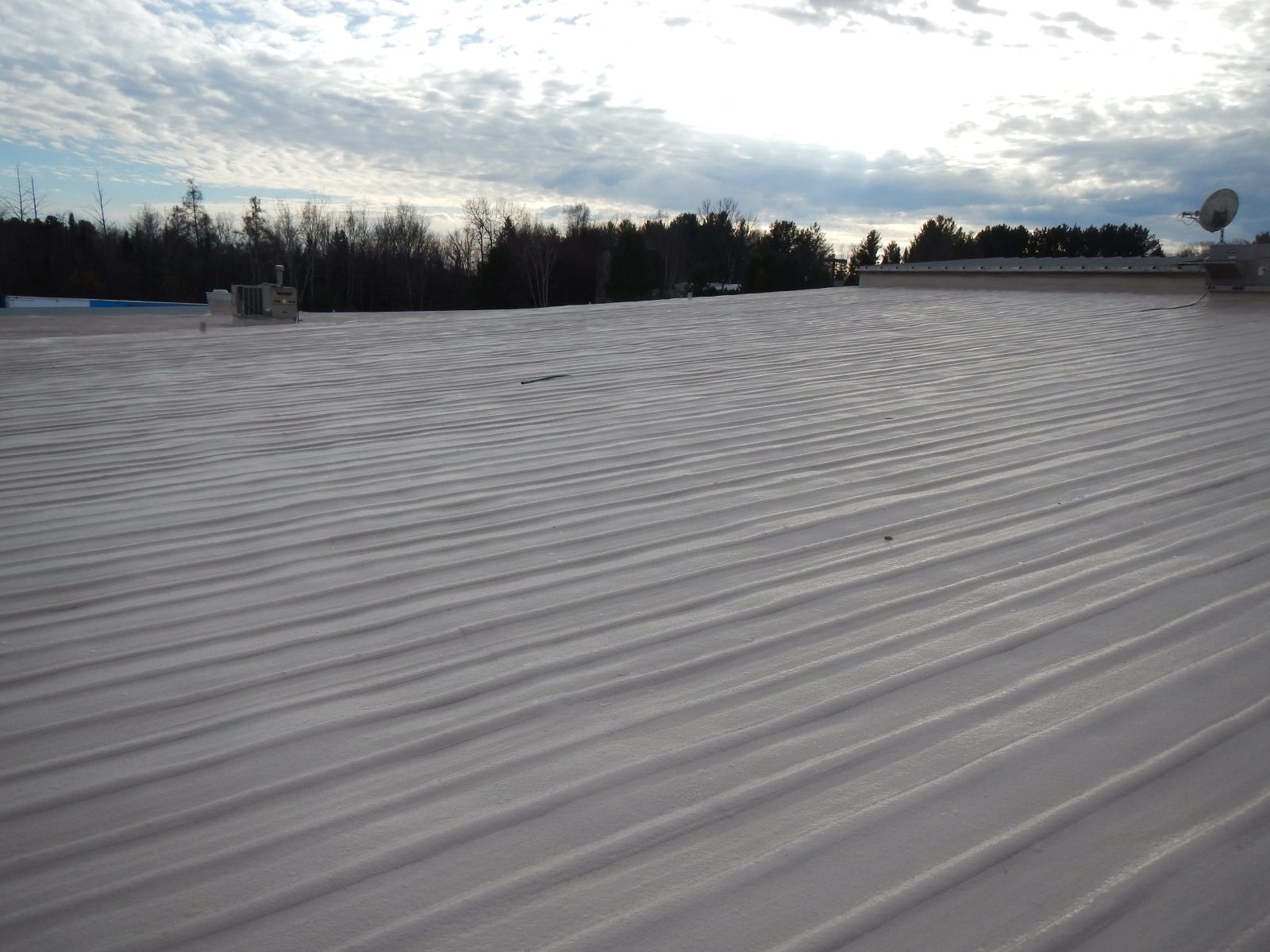
OR-80SLM Silver Lining Membrane is the choice when the deck is exposed and the coating is the roof. Pure polyurea, Miami-Dade approved, formulated for full weather-cycle service on metal roof decks and exposed structural decking.
OR7K Polyurea is the general waterproofing grade. It is what we spec on interior mezzanine decks, platform plate, and covered decking where the membrane is doing waterproofing and corrosion work but is not in permanent direct weather exposure.
Flak Jacket 1 (FJ1) steps in when the deck is a wear surface as well as a waterproofing surface. Catwalks, stair treads, equipment platforms, decking that takes cart traffic or dropped tooling. Higher build, higher tear strength, and the same seamless bridging over laps and fasteners.
Many jobs use two: FJ1 on the walking and working areas, OR-80SLM or OR7K across the rest of the deck field, sprayed continuous with no cold joint between them because polyurea bonds chemically to itself within the recoat window.
One honest note on appearance: aromatic polyurea chalks and fades in direct UV. It is cosmetic and does not affect waterproofing, corrosion resistance, or physical properties. Where long-term appearance matters, an aliphatic topcoat is available — ask and we will include it in the spec.
Need This in Submittal Form?
We will send complete TDS and SDS documentation, application instructions, and a written specification you can put into a project submittal.
Request DocumentationGet a Deck Coating Spec
Tell us about your project and we will follow up with product details, technical data sheets, and pricing.